
Customer Service Excellence Program
Program Overview Total duration: 24 hours (8 modules × 3 hours). Target audience: Frontline staff, call-centre agents, reception specialists, retail associates, service coordinators, and early-career team leads who interact directly with customers in Canadian workplaces. Delivery: Self-paced online or blended; …
Overview
Program Overview
- Total duration: 24 hours (8 modules × 3 hours).
- Target audience: Frontline staff, call-centre agents, reception specialists, retail associates, service coordinators, and early-career team leads who interact directly with customers in Canadian workplaces.
- Delivery: Self-paced online or blended; each module can stand alone but also builds toward a Customer Service Excellence Certificate.
Core Outcomes by the End of 24 Hours, Learners Will Be Able To:
- Demonstrate professional, courteous, and inclusive customer interactions across in-person, phone, email, and chat channels.
- Use structured questioning, active listening, and problem-solving steps to resolve customer issues efficiently.
- De-escalate common conflict situations while maintaining safety and protecting organizational reputation.
- Apply basic service standards, metrics (e.g., response time, first-contact resolution), and feedback loops to improve service quality.
- Use digital tools and AI assistants to support service tasks (drafting responses, summarizing cases) while protecting confidentiality and maintaining human judgment.
- Build resilience and professional wellbeing in high-contact customer service roles.
Curriculum
- 8 Sections
- 49 Lessons
- 24 Hours
- Foundations of Customer Service, Professionalism, and Canadian Context7
- 1.11. What Customer Service Does for Organizations
- 1.22. The Service Chain: From First Contact to Follow-Up
- 1.33. External vs Internal Customers
- 1.44. Professionalism and Service Mindset
- 1.55. Service Recovery and Boundary-Setting
- 1.66. Inclusive and Respectful Communication
- 1.7Activities (with self-check guidance) – Chapter 1
- Communication Skills Across All Channels6
- Understanding Customers and the Service Journey6
- Problem-Solving and Service Recovery6
- 4.11. Understanding the Problem: Symptoms vs Root Causes
- 4.22. Structured Problem-Solving: Listen → Clarify → Offer Options → Confirm → Follow-Up
- 4.33. Knowing When and How to Escalate
- 4.44. Service Recovery: Turning Failure Into Opportunity
- 4.55. Documentation and Organizational Learning
- 4.6Activities (with self-check guidance) – Chapter 4
- Managing Difficult Conversations and De-Escalation6
- Service Processes, Systems, and Digital Tools6
- Teamwork, Feedback, and Service Improvement6
- 7.11. Teamwork and Supporting Colleagues
- 7.22. Receiving Feedback: From Supervisors, Customers, and Quality Monitoring
- 7.33. Quality Monitoring and Performance Metrics
- 7.44. Identifying Patterns and Service Improvement
- 7.55. Collaboration and Celebrating Shared Success
- 7.6Activities (with self-check guidance) – Chapter 7
- Resilience, Wellbeing, and Capstone6
Instructor

You May Like

EXECUTIVE ASSISTANT PROGRAM
PROGRAM OVERVIEW Total Duration: 24 hours (8 modules × 3 hours each) Target Audience: Administrative professionals, executive assistants, office managers, and administrative coordinators in Canadian organizations Delivery: Self-paced...
Essential Communication Skills Program
Program Overview Total duration: 24 hours (8 modules × 3 hours). Target audience: Professionals seeking to enhance verbal and written communication skills, including managers, team...
Business Management
Program overview Total duration: 24 hours (8 modules × 3 hours). Target audience: Early-career supervisors, aspiring managers, small business owners, and college students in business...
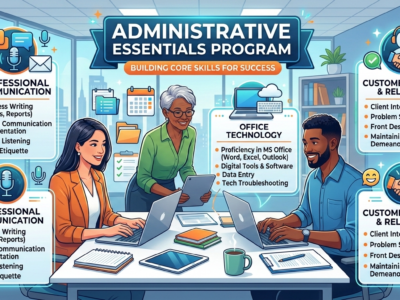
Administrative Essentials Program
The outline below presents a comprehensive, 24-hour professional development program for administrative professionals in Canadian organizations, structured in the same format and style as the...

Disaster Management In India
This 39-hour program provides comprehensive training on managing disasters specifically in the context of pandemics, such as COVID-19 or future outbreaks. It is designed for...

Course Features
- Lectures 49
- Quiz 0
- Duration 24 Hours
- Skill level All levels
- Language English
- Students 0
- Certificate No
- Assessments Yes